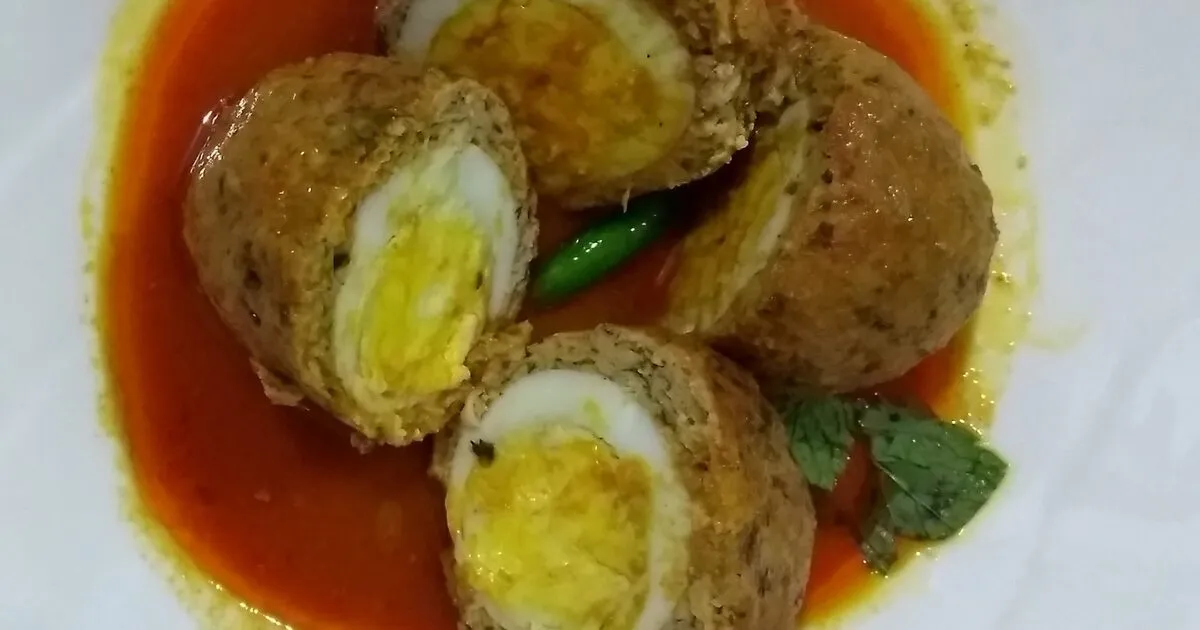
Nargisi kofta is the dish Mughlai cooks pull out when they want to impress: a whole hard-boiled egg hidden inside a spiced ground meat coating, simmered in a rich onion-yogurt gravy. Slice one open and you see why it is named after the nargis flower - a bright golden yolk ringed by white egg and dark, fragrant meat.
The dish comes from the royal kitchens of Awadh (modern Lucknow) and is served across India and Pakistan today, often at weddings and festive dinners. It is sometimes called the Indian Scotch egg, and food historians suggest the British version may actually be a colonial echo of this much older dish.
This recipe walks you through the full process: perfectly boiled eggs, a well-seasoned mince coating that seals cleanly, and a silky gravy that turns it into a celebration-worthy curry. No special equipment needed, just a skillet and a little patience.
Key Takeaways
- Nargisi kofta is a Mughlai meatball with a whole hard-boiled egg at its center.
- The name comes from the nargis (narcissus) flower, which the sliced kofta resembles.
- Seal the mince coating well and fry it briefly so the egg stays hidden through the simmer.
- The gravy is an onion-yogurt-tomato masala cooked until the oil separates.
- Serve with rice, naan, or roti to soak up the sauce.
How to Make Nargisi Kofta
- Hard-boil the eggs: cover them with water, bring to a boil, and cook for 8 minutes. Transfer to an ice bath, cool completely, and peel. Slightly under-cooked eggs are easier to wrap, but they must be firm enough to hold their shape.
- In a bowl, mix 1 1/2 lb ground lamb (or beef or chicken) with grated onion, 1 tbsp ginger-garlic paste, chopped green chili, cilantro, 2 tbsp chickpea flour, garam masala, cumin, coriander, chili powder, turmeric, and salt. Knead for a couple of minutes until the mixture is sticky and holds together. If it feels loose, add another teaspoon of chickpea flour.
- Divide the mince into 6 equal portions. Flatten one portion in a wet palm, place a peeled egg in the center, and press the meat up and around it, sealing any cracks so no egg shows through. Smooth the surface with damp fingers. Repeat with the remaining eggs.
- Heat 1/4 cup oil in a wide skillet over medium heat. Fry the koftas, turning every 2 to 3 minutes with a spatula, until browned all over, about 5 to 6 minutes total. They do not need to cook through at this stage - the gravy finishes them.
- Remove the koftas. In the same pot, add the sliced onions and cook over medium heat, stirring often, until deep golden brown, about 12 to 15 minutes. For a silky gravy, cool slightly and blend the onions smooth, then return them to the pot.
- Add 1 tbsp ginger-garlic paste and cook for 1 minute until fragrant. Stir in the tomato puree, whisked yogurt, garam masala, cumin, turmeric, chili powder, and salt. Cook, stirring, until the oil separates from the masala, about 6 to 8 minutes.
- Pour in 2 cups warm water and bring to a gentle boil, then reduce to a low simmer. Slide in the koftas in a single layer, cover, and cook for 20 to 25 minutes, spooning gravy over them halfway through.
- Stir in the cream if using, taste for salt, and serve hot with rice, naan, or roti. Garnish with extra cilantro and sliced green chili if you like.
Ingredients
For the koftas
- 6 large eggs
- 1 1/2 lb (680 g) ground lamb, beef, or chicken
- 1 small onion, finely grated and squeezed dry
- 1 tbsp ginger-garlic paste
- 1 green chili, finely chopped (optional)
- 1/4 cup chopped cilantro
- 2 tbsp chickpea flour (besan)
- 1 tsp garam masala
- 1 tsp ground cumin
- 1 tsp ground coriander
- 1/2 tsp chili powder (or Kashmiri chili for color)
- 1/2 tsp turmeric
- 1 1/2 tsp kosher salt
- 1/4 cup neutral oil, for frying
For the gravy
- 3 medium onions, thinly sliced
- 1 tbsp ginger-garlic paste
- 2 medium tomatoes, pureed
- 1/2 cup plain full-fat yogurt, whisked
- 1 tsp garam masala
- 1 tsp ground cumin
- 1/2 tsp turmeric
- 1/2 tsp chili powder
- 1 tsp kosher salt
- 2 cups (480 ml) warm water
- 2 tbsp heavy cream (optional)
What Is Nargisi Kofta?
Nargisi kofta is a meatball with a surprise inside: a whole hard-boiled egg wrapped in spiced minced meat, cooked in a rich onion-yogurt gravy. The word kofta comes from the Persian kuftan, meaning to pound, and it shows up all over Indian, Pakistani, and Middle Eastern cooking - see our kofta glossary entry for the full family.
What makes nargisi kofta special is the construction. Unlike a regular Indian meatball curry where the meatballs simmer directly in the sauce, nargisi kofta has to be shaped around an egg, sealed, and fried briefly to set the coating. The payoff is a dramatic sliced cross-section at the table.
It is a Mughlai dish, born in the royal kitchens of Awadh in the 18th century. The same court cooking produced kormas, biryanis, and kebabs built for royal feasts - and a meatball hiding a whole egg inside is exactly the kind of flourish those kitchens loved.
Why Is It Called Nargisi?
Nargis is the Urdu and Hindi word for the narcissus flower, and the dish is named for the way it looks when sliced open. The golden yolk forms the flower’s center, the white of the egg the petals, all framed by the dark meat coating. Mughal-era cooks were fond of naming dishes after flowers, and this one stuck.
You will sometimes see the dish called nargisi kofta curry, koftay ka salan, or Indian Scotch egg curry, but they all describe the same construction: egg in the center, meat on the outside, curry on top. The Indian meatball recipes roundup collects more of this family if you want to explore further.
Nargisi Kofta vs Scotch Egg
The resemblance is hard to miss: a boiled egg wrapped in meat, fried until golden. But the two dishes diverge at the table. A Scotch egg is a pub snack, served cold or warm with mustard, and usually breaded. Nargisi kofta goes into a spiced curry, never breaded, and is eaten as a main course with rice or bread.
Historians generally trace the Scotch egg back to colonial-era Britain, and a popular theory holds that British soldiers and officers in India encountered nargisi kofta and took the idea home. The Mughlai dish predates the Scotch egg by well over a century, so if you want the original, this is it.
Variations
Chicken nargisi kofta. Swap the lamb for ground chicken or turkey. Chicken is leaner, so add 2 tablespoons of neutral oil or butter to the mince and keep the simmer shorter - about 15 minutes - so it stays moist.
Vegetarian nargisi kofta. Mix grated paneer, boiled and mashed potato, and a little chickpea flour with the same spices, then wrap it around the eggs. It needs gentler handling, so chill the mixture for 20 minutes before shaping.
Air fryer nargisi kofta. Skip the frying pan and cook the assembled koftas in an air fryer at 375 F (190 C) for 10 to 12 minutes, turning once, until the coating is browned and firm. Then simmer them in the gravy as written.
Kashmiri or Mughlai gravy. For a richer sauce, replace half the water with chicken or lamb stock, or swirl in a tablespoon of cashew paste with the cream. For a different South Asian meatball in sauce, try our Kashmiri rista in saffron curry.
How to Serve Nargisi Kofta
Nargisi kofta is a sauced main course, so the sides are about soaking it up. Steamed basmati rice or jeera rice is the classic choice, and naan or roti works just as well for scooping the gravy.
To make the presentation shine, slice one kofta in half at the table before serving so everyone sees the egg inside. A side of raita or a simple salad balances the richness, and a squeeze of lemon over the top brightens the whole dish.
Storage
Leftover nargisi kofta keeps for 3 to 4 days in the fridge in an airtight container. Reheat gently on the stovetop with a splash of water so the gravy does not tighten.
You can freeze the assembled koftas before frying: place them on a parchment-lined tray, freeze until solid for about 2 hours, then transfer to a bag. Fry straight from frozen, adding a few extra minutes, or thaw overnight in the fridge first. The gravy itself freezes well for up to 3 months.
FAQ
What is nargisi kofta?
A Mughlai dish of spiced minced meat wrapped around a whole hard-boiled egg, fried to set, and simmered in a rich onion-yogurt gravy. The name comes from the nargis flower, which the sliced kofta resembles.
Why is it called nargisi kofta?
Nargis means narcissus in Urdu and Hindi. When a cooked kofta is sliced in half, the yellow yolk surrounded by white egg looks like the flower’s golden center and pale petals.
Is nargisi kofta the same as Scotch eggs?
They share the same construction - egg wrapped in meat - but nargisi kofta is an older Mughlai dish cooked in a spiced curry, while the Scotch egg is a British snack, usually breaded and served without sauce.
What meat is best for nargisi kofta?
Lamb or beef have enough fat to stay juicy through the simmer. Chicken or turkey work too if you add a little oil to the mince and shorten the cooking time.
Can I make nargisi kofta without eggs inside?
Yes. The same spiced mince makes excellent plain kofta - see our Indian meatball curry (kofta curry) for the egg-free version simmered directly in the sauce.
